
What Is Desiccated Coconut Powder?
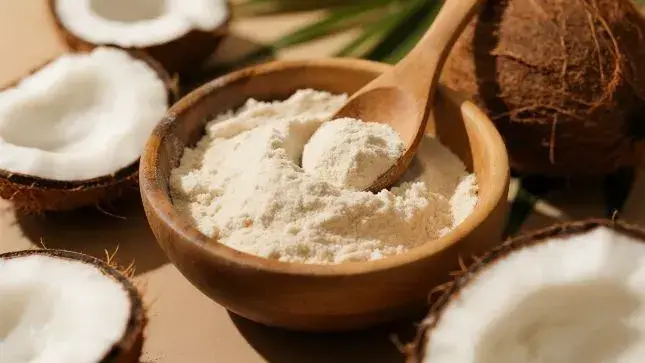
Desiccated coconut powder is produced from mature white coconut kernel. Manufacturers remove the husk, shell, and brown skin before washing, grinding, drying, and sieving the coconut meat.
The word “powder” can sometimes create confusion. Unlike coconut milk powder, desiccated coconut powder still contains the physical coconut kernel. It is dried and milled, but it does not dissolve completely in water.
According to the Codex Standard for Desiccated Coconut, the product comes from sound white coconut kernel. Its processing can include dehusking, paring, washing, comminuting, drying, and sifting. The standard also covers products from which manufacturers have partially extracted the oil.
A properly processed product should have a natural white or light creamy-white color. It should smell clean and characteristically coconut-like. Mouldy, smoky, fermented, cheesy, or rancid odors may indicate deterioration or poor storage.
However, commercial terminology still varies between suppliers. One producer may call a product “powder,” while another describes the same particle range as extra-fine or fine. Therefore, importers should check the sieve specification rather than relying on the product name.
High-Fat and Low-Fat Desiccated Coconut: Desiccated coconut specifications
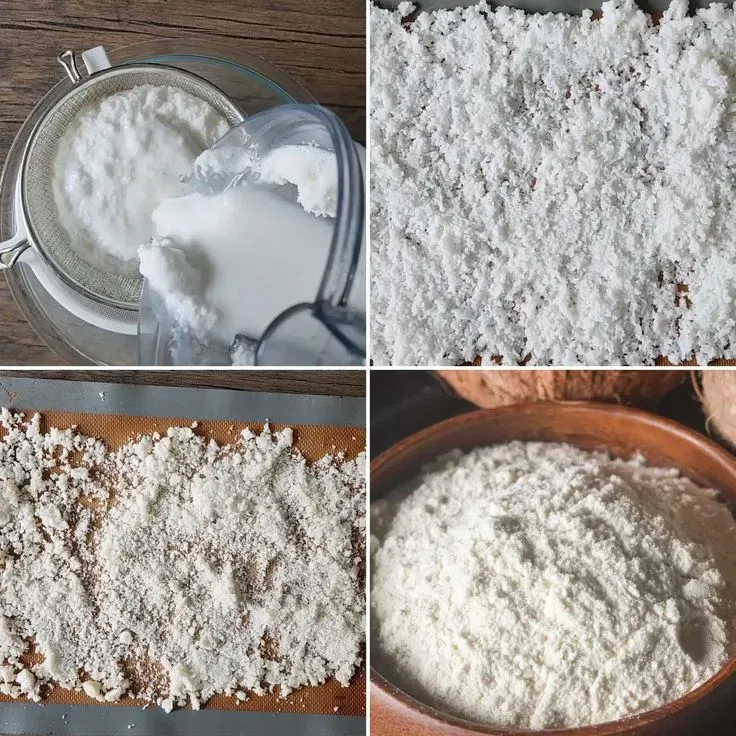
Fat content is one of the first specifications an importer should confirm. It shapes the product’s aroma, mouthfeel, texture, application, and commercial value.
High-fat desiccated coconut retains most of the natural coconut oil. As a result, it normally delivers a richer taste and stronger aroma. Manufacturers often choose it for chocolate fillings, cookies, macaroons, confectionery, and products where coconut must remain noticeable.
Low-fat desiccated coconut undergoes partial oil extraction before final milling. Consequently, it provides a lighter sensory profile and behaves differently inside a formulation. It can suit dry mixes, coatings, cereals, and products where cost or lower oil content matters more than richness.
The distinction should never rest on the grade name alone. Codex defines regular desiccated coconut as containing at least 60% oil. Partially defatted desiccated coconut contains at least 35% but less than 60% oil.
Commercial suppliers may use narrower ranges. For example, Takimex’s high-fat desiccated coconut powder lists a fat range of 62% to 68%. Meanwhile, BATA FOOD’s desiccated coconut range separates products into high-fat and low-fat grades across several particle sizes. These examples show why buyers should compare actual figures rather than sales descriptions.
| Comparison Point | High-Fat Desiccated Coconut | Partially Defatted Coconut |
|---|---|---|
| Codex oil category | At least 60% | At least 35% but below 60% |
| Sensory profile | Richer aroma and fuller mouthfeel | Lighter flavor and leaner texture |
| Typical applications | Confectionery, biscuits, fillings, macaroons, and toppings | Dry mixes, coatings, cereals, and selected industrial formulations |
| Main buyer check | Confirm the minimum oil content and production application | Confirm the remaining oil range and extraction level |
Importers should also check whether the laboratory reports oil on an “as-is” or dry-matter basis. Otherwise, two figures may appear comparable while following different calculation methods.
Most importantly, the intended application should guide the choice. A lower-fat option is not automatically inferior, and a higher-fat option is not always necessary. The right grade is the one that performs consistently in the buyer’s recipe and production line.
How Particle Size Changes Product Performance
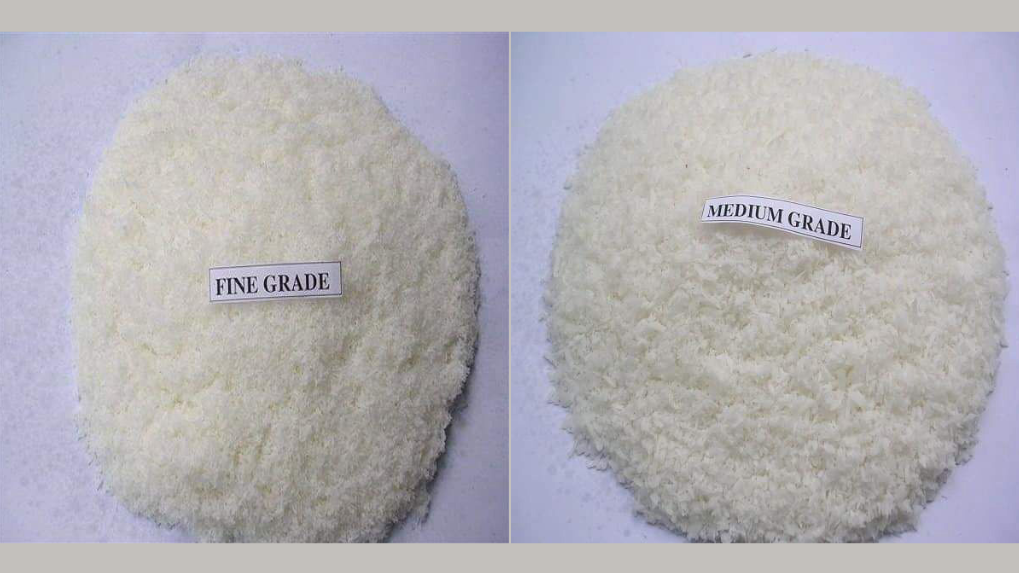
Particle size does more than change appearance. It influences how the ingredient blends, flows, absorbs moisture, covers surfaces, and feels in the finished product.
Extra-fine desiccated coconut powder can integrate smoothly into creams, fillings, seasonings, and dry mixes. Since the particles remain small, they create a more uniform texture and become less visible after processing.
Medium grade produces a more noticeable bite. Manufacturers often use it when visible coconut pieces support the final product’s appearance. Flakes, chips, and long shreds serve different purposes again, especially in toppings and decorative applications.
The Codex sizing system provides useful reference points. Extra-fine material should have at least 90% passing through a 0.85-millimeter sieve. Fine material should have at least 80% passing through a 1.40-millimeter sieve. Medium grade should have at least 90% passing through a 2.80-millimeter sieve. Codex also sets limits for the proportion of very small particles within each grade.
However, suppliers do not always follow the same commercial names. BATA FOOD presents extra-fine, fine, medium, and coarse options, while Takimex describes fine, medium, flakes, and chips using its own size ranges. Therefore, buyers should request the full sieve analysis for the offered product.
A production trial remains essential. A sample may have an attractive color and aroma but still create problems during automatic dosing. Very fine particles may form dust, while larger particles may block narrow filling equipment.
For this reason, procurement and production teams should approve the sample together. Purchasing can evaluate price and documents, while the technical team confirms processing performance.
Which Desiccated Coconut Specifications Should Bulk Buyers Check?
A useful specification sheet should tell the buyer exactly what the supplier promises to deliver. It should cover physical, chemical, sensory, and microbiological requirements, while also stating the relevant testing methods.
Buyers should not accept vague terms such as “standard quality” or “export quality.” These phrases offer little protection when a claim occurs. Instead, every important requirement should appear as a measurable limit.
The following table separates international reference points from requirements that buyers usually define themselves.
| Parameter | Reference or Buyer Requirement | Why It Matters |
|---|---|---|
| Oil content | At least 60% for regular grade; 35% to below 60% for partially defatted grade | Affects aroma, texture, formulation behavior, and price |
| Moisture | Codex maximum of 4%; commercial limits may be stricter | Influences stability, flow, and moisture-related deterioration |
| Extracted-oil acidity | Codex maximum of 0.3%, measured as lauric acid | Helps assess oil condition and process control |
| Ash | Codex maximum of 2.5% | Supports composition and cleanliness assessment |
| Particle size | Agreed sieve distribution for extra-fine, fine, medium, or special cuts | Changes texture, appearance, blending, and equipment flow |
| Sulfite status | Declared residual SO₂ limit or confirmed no-added-sulfite status | Affects color retention, labeling, and market compliance |
| Microbiology | Buyer-specific limits for Salmonella, E. coli, coliforms, yeast, mould, and total plate count | Supports food safety and border acceptance |
| Foreign matter | Codex requires absence in a 100-gram test portion | Reduces contamination risk and customer claims |
How Should Bulk Desiccated Coconut Powder Be Packed?
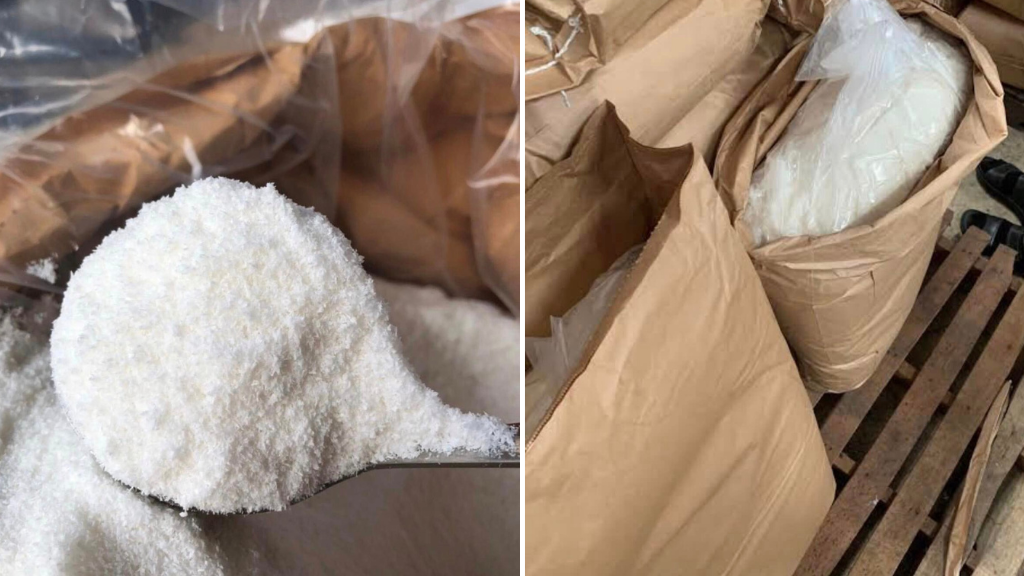
Packing protects the product long after it leaves the factory. A suitable bag must resist moisture, contamination, tearing, and odor absorption throughout handling and transport.
Most industrial packs combine a food-contact inner liner with stronger outer layers. The polyethylene liner creates a moisture barrier, while kraft paper or woven polypropylene provides physical protection.
However, net weight alone does not describe the packing quality. Buyers should confirm the number of layers, liner thickness, sealing method, outer material, pallet arrangement, and label format.
For example, BATA FOOD’s desiccated coconut product page lists 25-kilogram paper bags. Meanwhile, Takimex lists 25-kilogram and 50-kilogram three-layer bags using PE, kraft paper, and PP. These examples demonstrate how packing structures can differ between suppliers.
HAVIGO’s desiccated coconutpresents common net weights of 7, 10, 25, and 50 kilograms. Listed materials include food-grade PE liners, kraft paper, and PP woven protection. Final availability should still be confirmed for each grade and order.
Bag artwork also requires approval before production. The label should clearly identify the product, grade, net weight, lot, origin, production date, expiry date, and storage conditions.
Where sulfites apply, the label and documents must follow destination requirements. Importers should confirm the final wording with their customs broker or food compliance team before shipment.
How Can Importers Evaluate a Desiccated Coconut Powder Supplier?
Supplier evaluation should begin with the offered product, not the marketing presentation. The buyer needs to know which factory will produce the goods and which specification will govern the order.
First, compare the supplier’s specification with the intended application. Then review a recent sample COA, certification scope, factory address, packing details, and traceability process.
A certificate name alone is not enough. Buyers should check the issuing body, validity date, certified site, and covered product category. Some certificates may apply to another facility or production line.
The supplier should also explain how it controls raw materials, drying, sieving, pasteurization, metal detection, packing, and lot identification. Clear answers usually reveal whether the supplier understands industrial buyer requirements.
For new suppliers or sensitive orders, third-party inspection may provide additional control. The inspection scope can cover quantity, packing, labeling, container condition, sampling, and laboratory testing.
Importers should also agree on claim procedures before shipment. The contract should define the inspection timeline, supporting evidence, governing specification, and method for handling non-conforming goods.
Buyers sourcing from Vietnam can use HAVIGO’s guide to importing desiccated coconut alongside the main product page. The two resources help connect technical selection with packing, documents, and shipment planning.
Common Sourcing Mistakes That Lead to Claims
The most common mistake is comparing prices before aligning specifications. A high-fat fine product and a partially defatted medium product cannot support a meaningful price comparison.
Another frequent problem involves sample approval. Buyers sometimes approve color and aroma but never test the ingredient in production. Problems then appear during blending, baking, coating, or filling.
COA review can also become superficial. A document may look complete while lacking methods, lot traceability, or the buyer’s required parameters.
Packing creates another source of disputes. A bag may have the correct net weight but an insufficient moisture barrier. Likewise, weak seals or unsuitable stacking may cause damage during transport.
Finally, some buyers confirm documents too late. Import requirements can differ between markets, even for the same product. Therefore, document and labeling requirements should be finalized before production begins.
What is desiccated coconut powder used for?
Desiccated coconut powder is widely used in bakery, confectionery, cereals, fillings, coatings, snack bars, and dry food mixes. Fine grades blend smoothly into formulations, while medium grades create a more visible coconut texture.
What is the difference between high-fat and low-fat desiccated coconut powder?
High-fat desiccated coconut powder retains more natural coconut oil. Therefore, it offers a richer aroma and fuller mouthfeel. Low-fat grades undergo partial oil extraction and provide a lighter sensory profile. The right option depends on the buyer’s recipe, processing method, and target cost.
What specifications should buyers confirm before ordering?
Buyers should confirm fat content, particle size, moisture, sulfite status, microbiological limits, color, aroma, and packing. They should also review the approved sample, product specification, and lot-specific COA before shipment.
How should desiccated coconut powder be stored?
The product should remain in a cool, clean, and dry warehouse. Bags must stay away from sunlight, moisture, pests, chemicals, and strong odors. Once opened, the inner liner should be resealed quickly to protect product quality.
Where can importers buy bulk desiccated coconut powder from Vietnam?
Importers can source desiccated coconut powder from HAVIGO for food manufacturing, wholesale, and distribution. HAVIGO supports buyers with grade selection, specification matching, packing options, COAs, export documents, and FOB or CIF shipment arrangements.
Source Desiccated Coconut Powder from HAVIGO
Choosing the right desiccated coconut powder starts with a clea desiccated coconut specifications, not only a target price. Buyers should confirm fat content, particle size, moisture, sulfite status, microbiological limits, packing, and required documents before placing an order.
HAVIGO supplies -bulk desiccated coconut powder for importers, distributors, wholesalers, and food manufacturers. Buyers can explore HAVIGO’s desiccated coconut product range to review available grades, packing options, storage guidance, and export support. We also assist with specification matching, sample review, COAs, export documents, and FOB or CIF shipment arrangements.
To receive an accurate quotation, please share your required grade, fat content, particle size, packing, order quantity, destination port, and expected shipment schedule. HAVIGO will review the details and recommend a suitable product for your market.d